
THE FIRST AI CINEMA CAMERA
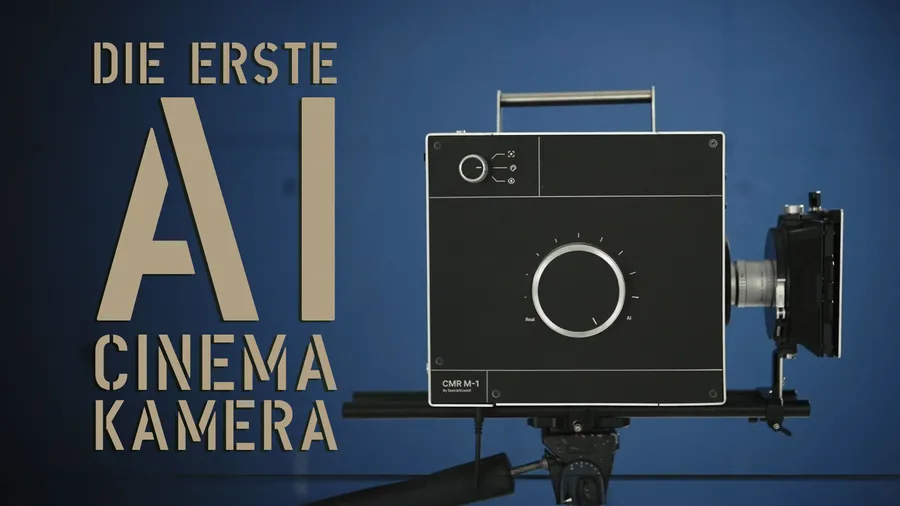
You have to see this. The first AI cinema camera. Anyone who thought AI only happens on the computer – wrong! This camera has AI built in.
It is the CMR-M1, also known as Camera One. I love consonant abbreviations: DSGN for DESIGN. The design of the Camera One is actually inspired by the Cine Kodak 16-millimeter film camera.
The first widely distributed and produced 16-millimeter film camera.

So it’s a bit of a historical nod.
What the Camera One can do on the go, I tried out on the computer. That is: LIVE-CAMERA-AI-VIDEO. That was a ton of fun. How that works – right – we’ll look at at the end of the post!
But back to the camera: here we have the first camera that integrates Gen-AI technology, i.e. generative AI, directly into the video recording process, without having to move the footage to a computer.
We’ll get to the technical specifications in a moment, but I want to make clear that this is more of an experimental prototype. It is not available for commercial sale. All the unboxers and Marques Brownlee too can lie back down and enjoy the show.
The camera is a collaboration between Special Guest X and First Avenue Machines. You’ll find links in the description and of course on the ALPHATESTER blog. These people also developed the first AI video editing station. I’ll tell you about that later, it’s pretty wild too. And as a random side note, First Avenue Machines is also responsible for the OK Go music video for “The Writing’s On the Wall”. They play with some cool perspective illusions there.
Back to the Camera One. It uses a FLIR sensor, i.e. a Forward Looking Infrared sensor. Looks like those thermal imaging cameras. But it’s for machine vision. That is, specifically for computer programs to extract information from the image.
The camera records fairly normal-looking video and then stylizes it via a video-to-video process using Stable Diffusion. It comes with five LoRAs preinstalled. Doesn’t ring a bell? It’s basically a preset, a style direction to be applied to the image. The looks here are, for example, “Pixel Art”, “Blooming Nature” or “Cosmic Coma”.
Now you could of course simply control that through a menu setting on a dial. Not on the Camera One. The LoRAs are loaded via a card slot, and this card uses NFC chips. NFC chips are Near Field Communication. Ever paid with your phone or watch? NFC makes it possible. If you’re more interested in NFC – I made a post about biohackers, body modders and cyborgs. I implanted an NFC/RFID chip in my hand myself some time ago.
Well – anyway – NFC is unnecessary in this case but stylish! All the card does is activate a pre-defined menu item.
The camera apparently has interchangeable standard 16-millimeter film lenses and a pretty filter box. But the best part: this huge vintage analog knob. A nod to the crank on its historical predecessor. It sets the strength of the AI video stylization applied to the footage.
Ultimately, of course, it depends on what the footage looks like. And, well, actually not that bad. It simply has that Stable Diffusion video-to-video look. The resolution is 1360 x 768 pixels at 12 frames per second – none of it very high numbers. In this first version the footage isn’t processed on the device but uploaded to a cloud server that does the video-to-video processing and then sends it back to the camera. So it doesn’t happen in real time. Again, that’s just for the first prototype.
One of my fears as a media guy was/is that I never get away from the edit suite at all. The CMR M1 is therefore also a call to all AI creators to go out into the fresh air again and enjoy the sun again!
Is this the future of cinema cameras? Probably not. An inspiration for the whole industry – yes, definitely! Even though we’re only seeing a prototype here – it should be noted that the camera’s design was developed to be scalable for commercial production. So we might be able to buy this model at some point in the future after all.
But that’s not the only prototype. Special Guest X researches physical interfaces for generative AI. Last year they built the first AI machine, a physical AI video production and editing station. Pretty crazy thing. A hardware device that lets you create storyboards or images, as shown in the clip here. A bit like an LTX Studio come true.
Here you have six individual frames. Each frame stands for a video clip. With a knob you can set a LoRA, i.e. a preset. And here you can choose a music genre. Like on the computer you press render, and drumroll – your film is done. A speaker is built in too – so a standalone AI video generating device. Powered by Runway’s Gen 2. Applications? Depends on the render time – maybe for visual artists who show live projections at concerts. But they actually create their material completely in advance. So rather a party gag or party gadget. Do I want one? Definitely!
But now let’s come to the most exciting part of this episode. The channel isn’t called ALPHATESTER for nothing. I tried to simulate this technology, a LIVE AI camera, with the computer. For that I connected this GoPro to the computer. It sends an image of me to the computer. And I now use that image in KREA AI. There is an option there to use a webcam as a template.
On KREA AI I can work quite classically with just a prompt. But also insert photos, share screens and indeed insert a webcam. Then we need a suitable prompt: I’ll take “control station on the moon, astronaut wearing helmet”. With this slider, analogous to the big dial on the Camera One, I can set the strength of the AI. Let’s see what happens. The further I move the slider to the right, i.e. toward MORE AI, my edit suite disappears and voilà – there’s the moon base. And yes – the resolution isn’t exactly high, the scenery and people jump too much and the frame rate isn’t particularly high either. But you’re forgetting an important point! It’s insanely fun! Of course I played around with this technique – but just take a look. Also listen to the sound effects. They were made with a new AI too. I’ll show you after the clip.
Funny, right? What was your favorite? I’m torn between the biker and the sheep. Feel free to write it in the comments. In my tests I also played with a zombie prompt. But the results turned out rated 18 – well, at least rated 16. That’s why this video is only for people aged 18 and over:
Almost forgot! The sound effects are from https://www.videotosoundeffects.com/
There you can simply throw in a small clip and the AI creates four different sound effects.
Just try it out.
Do you need this now? For what? The composition of an AI image is often a difficult task. What goes where? Which prompt works, which doesn’t? I can intervene directly here, by hand. From my experiments I could now export single frames, upscale them right away or throw them into any other AI tool to make a video out of them.
The people at Special Guest X and First Avenue Machines have definitely secured their Wikipedia entry.
First Avenue Machines: https://www.1stavemachine.com
Special Guest X: https://www.specialguestx.com/
OK Go – The Writing’s On the Wall https://youtu.be/oL3qDpubXU8?si=K-SpDsZFhh2pZWF7
KREA AI: https://www.krea.ai/home
SOUND FX: https://www.videotosoundeffects.com/
AICinemaCamera #CMRM1 #AIinFilm #FilmTechnology #FutureOfFilm #AIinAction #InnovativeTechnology #AIinCameras #FilmProduction #StableDiffusion #VideoToVideo #TechPrototype #FilmCamera #SpecialGuestX #FirstAvenueMachines #AIRevolution #TechInnovation #DigitalFilmmaking #Cinematography #NewTech #CreativeTechnology #FilmEquipment #CameraInnovation #FilmmakingTools #NextGenTech #AIPrototype #TechReviews #FilmIndustry #CreativeTechnology #TechGadgets #VideoProduction #DigitalRevolution